



Build-to-rent insurance is not just a closing requirement or a box to check before lease-up. It protects the project through several risk stages, from construction to vacancy to tenant occupancy. The right coverage can help investors protect the asset, satisfy lender requirements, reduce liability exposure, and preserve rental income after a covered loss.
This guide explains what build-to-rent insurance means, why investors need coverage before the first tenant moves in, and how to consider insurance as part of the overall investment model.
What Is Build-to-Rent?
Build-to-rent, also called build-for-rent or BTR, refers to homes built specifically for rent rather than for sale to individual homeowners.
These projects can include:
- Single-family rental homes
- Townhome rental communities
- Duplexes or small multifamily rentals
- Horizontal apartment-style communities
- Master-planned rental neighborhoods
- Scattered-site new construction rentals
Unlike fix-and-rent investing, build-to-rent starts with a rental strategy before construction begins. The investor, developer, or operator usually plans the property layout, finishes, amenities, leasing model, and long-term ownership structure around specific rental demand.
That makes insurance more complex than a standard landlord policy for an existing tenant-occupied home.
Why Build-to-Rent Insurance Matters Before the First Tenant
Many investors consider landlord insurance when a tenant is ready to sign a lease. For build-to-rent projects, that is often too late.
However, the risk begins before rent begins.
A property can suffer damage, theft, weather-related losses, vandalism, construction delays, liability claims, or financing issues before the first tenant moves in. If the project is uninsured or insured incorrectly during that gap, the investor may absorb losses directly.
Build-to-rent insurance matters before the first tenant because it helps protect:
- The construction budget
- Materials and fixtures
- Completed but vacant units
- Investor equity
- Lender requirements
- Liability exposure
- Future rental income
- Lease-up timing
- Portfolio performance
A delayed project does not just create a repair bill. It can also delay rent collection, reduce projected returns, and create pressure with lenders or capital partners.
Build-to-Rent Insurance vs. Standard Landlord Insurance
A standard landlord insurance policy is usually designed for a completed rental property that is already tenant-occupied or ready for occupancy.
Build-to-rent investors often need to think beyond that.
For build-to-rent projects, timing is everything. A policy that works during construction may not work once tenants move in. A landlord policy may not cover a property that is still under construction. A homeowners policy is generally not appropriate for a property built and held as a rental.
The Build-to-Rent Insurance Timeline
Insurance should follow the property lifecycle. Investors should not wait until lease-up to think about coverage.
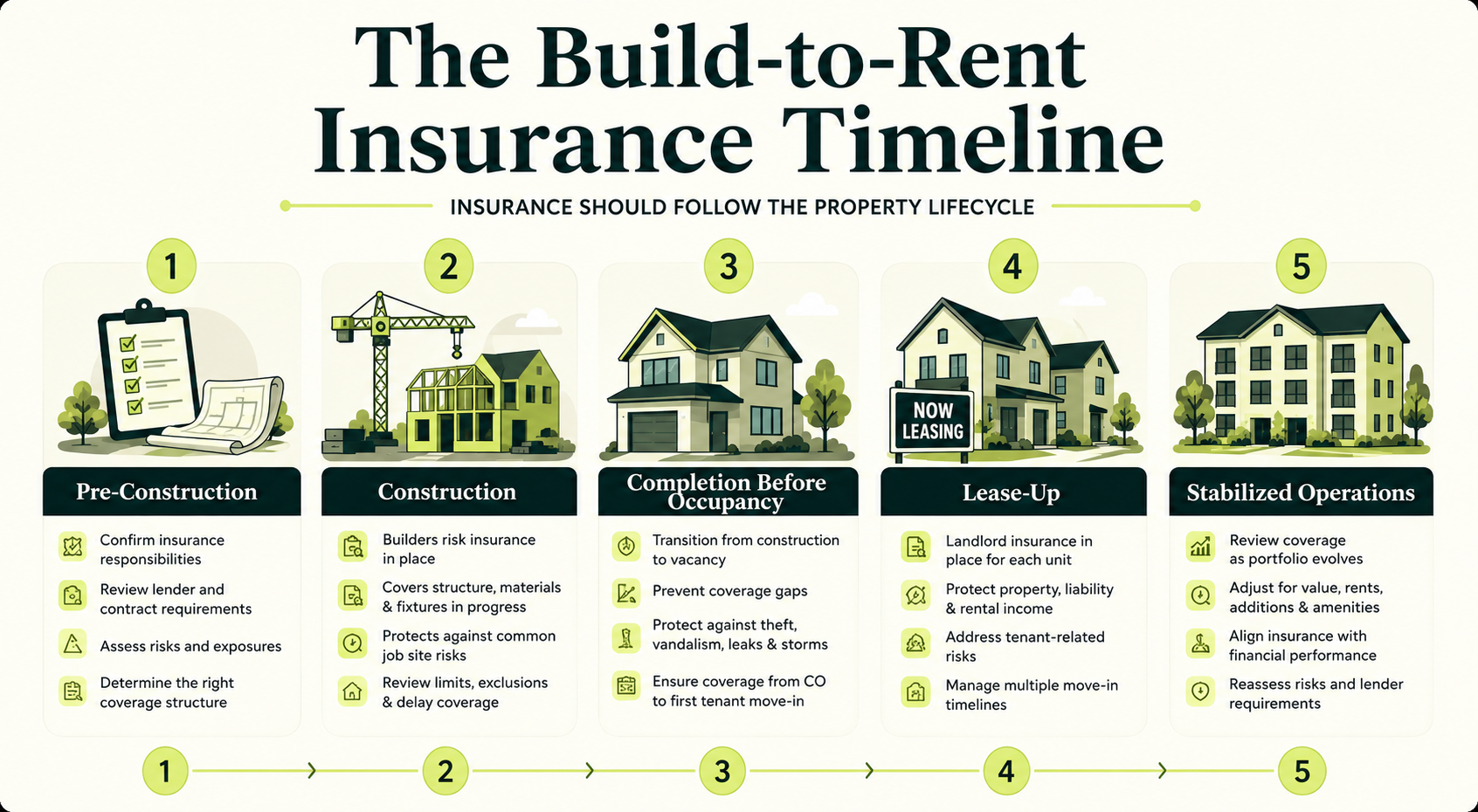
Phase 1: Pre-Construction
Before construction begins, investors should confirm who is responsible for insurance under the development agreement, construction contract, loan documents, and ownership structure.
Questions to ask:
- Who owns the land during construction?
- Who is responsible for insuring the project?
- Does the lender require specific coverage limits?
- Will the builder carry general liability?
- Is the owner listed as an additional insured where needed?
- Are subcontractors required to carry insurance?
- Are materials covered if stored off-site or in transit?
- Are there flood, wind, wildfire, or hail exposures?
At this stage, investors should also identify whether the project needs a single-site policy, a master policy, or coverage for multiple properties.
Phase 2: Construction
During construction, builders risk insurance is often the central property coverage.
Builders risk insurance can help protect a structure, fixtures, and materials while the project is being built. Depending on policy terms, it may also cover certain materials stored off-site or in transit.
Common risks during this phase include:
- Fire
- Theft
- Vandalism
- Wind or hail
- Lightning
- Certain water damage events
- Damage to materials
- Job site losses
- Construction-related delays
Coverage details vary by policy. Investors should review exclusions, limits, deductibles, soft cost coverage, ordinance or law coverage, and whether delay-related losses are included or excluded.
Phase 3: Completion Before Occupancy
A build-to-rent unit may be finished before a tenant moves in. This creates an important transition period.
The home is no longer fully under construction, but it may not yet be tenant-occupied. That vacant or lease-up period can create coverage gaps if the builders risk policy has ended and the landlord policy has not started.
Risks during this phase include:
- Theft of appliances or fixtures
- Vandalism
- Water leaks
- Storm damage
- Liability from tours or showings
- Damage before the lease starts
- Delayed occupancy after final inspection
Investors should confirm when builders risk coverage ends and when landlord coverage begins. Ideally, there should be no uninsured gap between the certificate of occupancy and the first tenant move-in.
Phase 4: Lease-Up
Lease-up is when the project starts converting from development risk to operating risk.
During lease-up, investors should have landlord insurance in place for completed rental homes. This coverage typically helps protect the dwelling, landlord liability exposure, and rental income if a covered event makes the property uninhabitable.
Lease-up also introduces tenant-facing risks, such as:
- Slip-and-fall claims
- Tenant-caused damage
- Appliance leaks
- Fire or smoke damage
- Pet-related property damage
- Common area liability
- Rent loss after a covered event
If multiple homes are leased at different times, investors may need a clear process for moving each unit into the correct insurance status.
Phase 5: Stabilized Operations
Once the build-to-rent community is leased and operating, insurance becomes part of the portfolio management process.
Investors should review coverage regularly as:
- Rent increases
- Replacement costs change
- Units are added
- Amenities open
- Common areas expand
- Claims history develops
- Property management changes
- Local weather risks shift
- Lender requirements change
For larger BTR portfolios, insurance should be reviewed alongside NOI, cap rate, debt service coverage, cash-on-cash return, and reserve planning.
How Insurance Affects Cash-on-Cash Return and Cap Rate
Build-to-rent investors often evaluate deals using cash-on-cash return, cap rate, and net operating income.
Insurance directly affects these metrics because premiums are operating expenses.
Insurance and Net Operating Income
The basic formula is:
NOI = Gross Rental Income − Operating Expenses
Insurance is one of those operating expenses.
If premiums rise, NOI falls unless rent, occupancy, or other expenses improve.
Insurance and Cap Rate
The basic formula is:
Cap Rate = NOI ÷ Property Value
If insurance costs increase and NOI decreases, the cap rate can decline.
For example:
A $30,000 annual increase in operating expenses reduces NOI and lowers the cap rate.
Insurance and Cash-on-Cash Return
The basic formula is:
Cash-on-Cash Return = Annual Pre-Tax Cash Flow ÷ Total Cash Invested
If insurance costs increase, annual cash flow may decrease. That reduces cash-on-cash return unless the investor increases rent, reduces other expenses, improves occupancy, or invests less cash.
This is why build-to-rent insurance should be quoted early. Waiting until the end of construction can create unpleasant surprises in the investment model.
Build-to-Rent Insurance Checklist Before the First Tenant
Before the first lease is signed, investors should confirm the following:
Build-to-Rent Insurance Cost Factors
Build-to-rent insurance costs vary by project. Insurers may consider:
- Location
- Number of units
- Property type
- Construction type
- Roof age and materials
- Replacement cost
- Distance to fire services
- Weather and catastrophe exposure
- Vacancy status
- Lease-up timeline
- Security features
- Claims history
- Property management experience
- Tenant profile
- Amenities
- Deductibles
- Coverage limits
- Prior insurance history
Investors should request insurance estimates early in the underwriting process. A deal that works with one premium assumption may look different once real quotes are available.
How to Reduce Build-to-Rent Insurance Risk
Investors cannot control every insurance factor, but they can make the property easier to insure.
Practical steps include:
- Use durable building materials
- Install water leak detection where appropriate
- Maintain clear site security during construction
- Add lighting around common areas
- Keep units inspected during vacancy
- Document construction quality and updates
- Require contractor certificates of insurance
- Require renters insurance in lease agreements
- Create a maintenance response plan
- Keep roofs, HVAC, plumbing, and electrical systems documented
- Disclose amenities accurately
- Review coverage after each project phase
Insurance companies evaluate risk. Better documentation and risk controls can support a stronger underwriting file.
Protect Your Build-to-Rent Investment with Obie
Build-to-rent investors need coverage that keeps pace with the property lifecycle, from vacant units to active leases and growing portfolios.
Obie helps real estate investors find landlord insurance designed for rental properties, including single-family rentals, multifamily properties, and expanding portfolios. Get a personalized quote before the first tenant moves in and make sure your rental investment is protected from day one.
FAQs
Do I need insurance before my first build-to-rent tenant moves in?
Yes. Risk starts before rental income begins. Construction damage, theft, vandalism, weather events, liability claims, and vacant-unit losses can happen before the first lease is signed.
Is builders risk insurance the same as landlord insurance?
No. Builders risk insurance generally covers property during construction or major renovation. Landlord insurance generally covers completed rental properties once they are operating as rentals.
When should I switch from builders risk to landlord insurance?
Investors should review coverage before construction ends and before the certificate of occupancy or first tenant move-in. The goal is to avoid any uninsured gap between construction coverage and landlord coverage.
Does landlord insurance cover vacant build-to-rent units?
It depends on the policy. Some policies have vacancy conditions or limitations. Investors should disclose lease-up status and confirm how completed but vacant units are covered.
What affects the cost of build-to-rent insurance?
Cost factors include location, number of units, construction type, replacement cost, weather risk, vacancy status, amenities, coverage limits, deductibles, claims history, and property management experience.
Can one policy cover multiple build-to-rent properties?
Some investors may qualify for portfolio coverage or policies structured for multiple properties. The right setup depends on ownership structure, location, property count, carrier guidelines, and lender requirements.
Why is insurance important for build-to-rent returns?
Insurance affects operating expenses, net operating income, cash-on-cash return, and cap rate. A higher premium can reduce returns, while inadequate coverage can expose the investor to larger losses after a claim.


.svg)