



Every real estate investor hits the same fork in the road. You have some capital, you are ready to buy a rental, and you have to decide: one house with one tenant, or one building with several?
It feels like a simple question. It is not. The choice between single-family and multifamily shapes how you finance the deal, how much cash flows in each month, what happens when a tenant leaves, how fast you can grow, and how easily you can sell when the time comes.
Neither one is universally "better." They are different tools for different goals. This guide breaks down exactly how they compare across the factors that actually move your returns, so you can pick the strategy that fits your capital, your time, and where you are headed.
Multifamily vs Single-Family at a Glance
The takeaway from this table: single-family wins on simplicity and accessibility, while multifamily wins on cash flow and scale. Now let's unpack why.
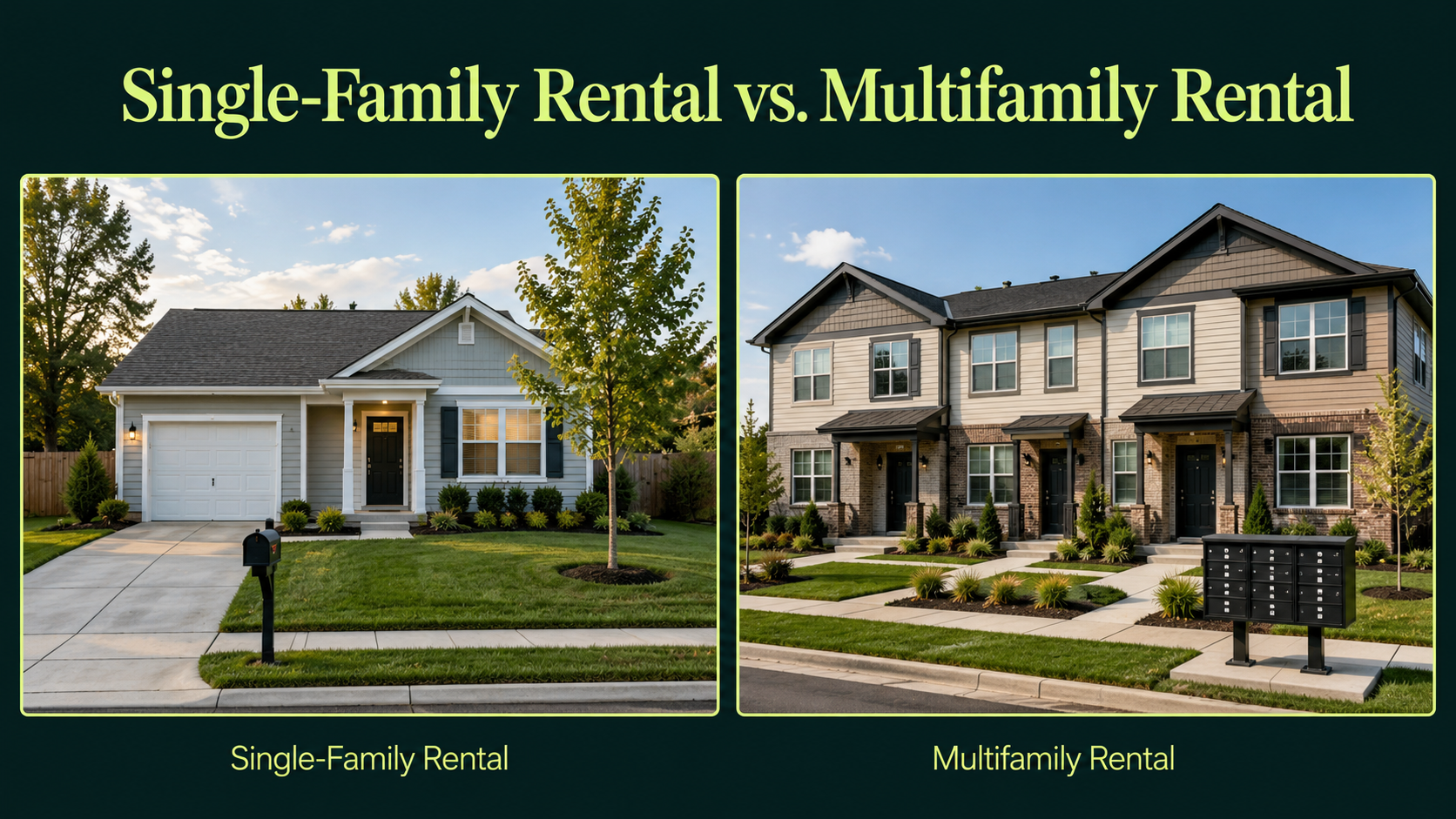
What Is a Single-Family Rental?
A single-family rental, or SFR, is a standalone home rented to one household. Think of a typical three-bedroom house with its own lot, not a unit inside a larger building.
It is the most common entry point into rental investing, and for good reason. The barrier to entry is low, financing is straightforward, and the property appeals to a broad market of both renters and future buyers. If you are buying your first rental, this is usually where you start.
What Is a Multifamily Property?
A multifamily property contains two or more separate living units in a single building or complex. Duplexes, triplexes, and fourplexes sit at the small end. Apartment buildings with dozens of units sit at the large end.
One distinction matters more than any other here, because it changes how you finance the deal:
- Two to four units are still treated as residential property. You can finance them with a conventional residential mortgage, and in some cases far less money down.
- Five or more units cross into commercial territory. Lenders underwrite these based on the property's income, not just your personal finances, and the loan terms change accordingly.
That single line, four units versus five, is one of the most important thresholds in all of real estate investing. Keep it in mind as we work through the differences.
The Key Differences for Investors
Entry Cost and Financing
This is where most decisions get made, because it determines what you can actually afford to buy.
A single-family rental is the cheapest way in. As a straight investment property, conventional lenders typically want 15% to 25% down, plus cash reserves. You qualify based largely on your own income and credit.
Small multifamily (two to four units) is more interesting than people expect. As an investment, the down payment is similar to a single-family rental. But if you are willing to live in one unit, a strategy called house hacking, the math changes dramatically. Owner-occupied two-to-four-unit properties can be financed with an FHA loan for as little as 3.5% down, or a conventional loan for as little as 5% down, while you collect rent from the other units. It is one of the most accessible on-ramps in real estate.
Five-plus-unit multifamily plays by commercial rules. Lenders qualify the deal based on the building's income and debt-service coverage rather than your salary alone. Expect 20% to 30% down, interest rates roughly one to two points higher than residential, shorter loan terms, and sometimes balloon payments. The upside: because approval leans on the asset's performance, a strong property can carry a lot of the qualifying weight.
Cash Flow and Economies of Scale
Multifamily wins here, and it is not particularly close.
A single-family home produces one rent check. After the mortgage, taxes, insurance, and maintenance, the monthly cash flow on any single property is usually modest.
A multifamily property stacks several rent checks under one roof, and it spreads costs in your favor. One roof, one lot, and often one set of major systems serve multiple paying units. That is the power of economies of scale: your cost per unit for maintenance, management, and repairs drops as the unit count rises. The result is typically stronger, more efficient cash flow than the same dollars spread across scattered single-family homes.
Vacancy Risk
This is the difference that keeps investors up at night, and it favors multifamily clearly.
With a single-family rental, occupancy is binary. The tenant is either there or they are not. When that one tenant moves out, you lose 100% of the property's income until you fill it, while the mortgage keeps coming due. That is why disciplined single-family investors set aside a vacancy reserve.
A multifamily property spreads that risk. A vacancy in one unit of a fourplex costs you roughly 25% of that building's income, not all of it. The other units keep paying. More units mean more stability, which is a big reason lenders and investors view multifamily income as more dependable.
Appreciation and How Each Is Valued
The two property types do not just earn differently. They are valued differently, and that is a subtle point that sophisticated investors use to their advantage.
A single-family home is valued on comparable sales, what similar nearby homes have sold for. Its value rises and falls with the local market, and because owner-occupant buyers compete for these homes, single-family tends to capture strong market appreciation over time. The downside: you have little control over it. The market moves the value, not you.
Larger multifamily is valued on net operating income and the local cap rate, essentially how much money the property produces. This means you can force appreciation: raise rents, cut expenses, or improve operations, and you directly increase the building's value. Returns here are driven more by income performance than by market luck, which gives the operator real control.
In short: single-family leans on market appreciation, multifamily lets you engineer it.
Management Complexity
Single-family is simpler to manage. One tenant, one set of systems, one lease. Many investors self-manage their first few homes, or use turnkey providers and property managers without much strain.
Multifamily is more demanding. More tenants mean more turnover, more maintenance requests, and more moving parts, which is why larger buildings are usually run by professional management. The saving grace is that the management cost gets spread across all those units, so it stings less per dollar of rent than it would on a single home.
Scalability
If your goal is a big portfolio, the two paths feel very different.
Scaling with single-family means many separate transactions, often in different neighborhoods or even different states, each with its own closing, loan, and logistics. It works, but it is a grind.
Multifamily scales by the unit. A single ten-unit acquisition adds ten income streams in one closing. The trade-off is that these deals are larger, more competitive, and harder to break into, so you typically need more capital and experience to play.
Liquidity and Exit
When it is time to sell, single-family has the edge. Your buyer pool includes every other investor plus every family that wants a home to live in. That demand makes single-family homes faster and easier to sell.
Multifamily, especially five-plus units, sells only to investors who run the numbers on income and cap rate. The buyer pool is smaller and deals take longer to close, which makes these properties less liquid, even as the income-based valuation gives serious buyers a clear framework to price them.
So Which Should You Invest In?
There is no universal winner, only the right fit for your situation.
Single-family tends to make sense if you:
- Are newer to investing and want a simpler, lower-risk start
- Have limited capital for a down payment
- Want maximum flexibility and an easy future resale
- Prioritize long-term market appreciation
Multifamily tends to make sense if you:
- Want stronger, more efficient monthly cash flow
- Want to insulate yourself from the all-or-nothing vacancy risk of a single tenant
- Are ready to scale a portfolio quickly
- Want more control over forcing value through better operations
For many investors, it is not either/or. A common path is to start with one or two single-family rentals to learn the business with accessible financing, build capital and experience, then graduate into multifamily when you are ready to prioritize cash flow and scale. House hacking a small two-to-four-unit property is a popular bridge between the two.
Don't Overlook Insurance
Whichever side you land on, the property type changes your risk profile, and therefore your coverage needs.
A single-family rental is typically protected by a landlord policy covering the structure, liability, and loss of rental income if a covered event forces your tenant out. Multifamily carries more exposure, more units, more tenants, more liability surface, and often calls for higher limits or commercial-grade coverage. And once you hold several properties, a portfolio or master policy that consolidates everything under one renewal can save real time and money.
The mistake to avoid is insuring a rental with a standard homeowners policy. Those policies often exclude the business activity of renting, which can leave a claim denied at the worst possible moment. Coverage built forsingle-family rentals andmultifamily properties is designed around the risks landlords actually face, including the all-important loss-of-rent protection.
Protect the Property You Built
The smartest investors move fast on the right deal, then protect it just as fast. That is the gap Obie was built to close.
We replaced the slow, paperwork-heavy insurance process with instant, data-driven coverage made specifically for rental properties, whether you own a single home or a growing portfolio of multifamily buildings. No 10-page PDFs, no waiting days for a quote, no homeowners policy that quietly excludes your rental income.
Ready to protect your next investment?Get a bindable quote in minutes and keep your focus where it belongs: on growing your portfolio.


.svg)