



If you have ever scrolled a commercial property listing and seen "NNN" next to the rent, you have already run into a net lease. It is one of the most common structures in commercial real estate, and it quietly answers a question that decides whether a deal is a headache or a paycheck: who actually pays for the property's running costs?
In a net lease, the answer is usually "the tenant." That single shift changes how the rent is priced, how much work the owner does, and how predictable the income is. Below, we break down exactly what a net lease is, the different types you will encounter, and what each one means whether you are buying the building or signing as the tenant.
Net Lease vs. Gross Lease: The Core Idea
Every commercial lease sits somewhere on a spectrum defined by who absorbs the operating costs.
At one end is the gross lease. The tenant pays a single rent number, and the landlord uses it to cover property taxes, insurance, maintenance, and other expenses. Simple for the tenant, but the landlord carries all the risk if those costs rise.
At the other end is the net lease. The tenant pays a lower base rent and then takes on some or all of the operating expenses directly. The landlord's income becomes steadier because rising costs are no longer their problem.
In the middle sits the modified gross lease, where the two sides split expenses in whatever way they negotiate. But the heart of the net lease concept is that classic trade: the tenant accepts a lower base rent in exchange for picking up the building's costs.
The Three "Nets" Explained
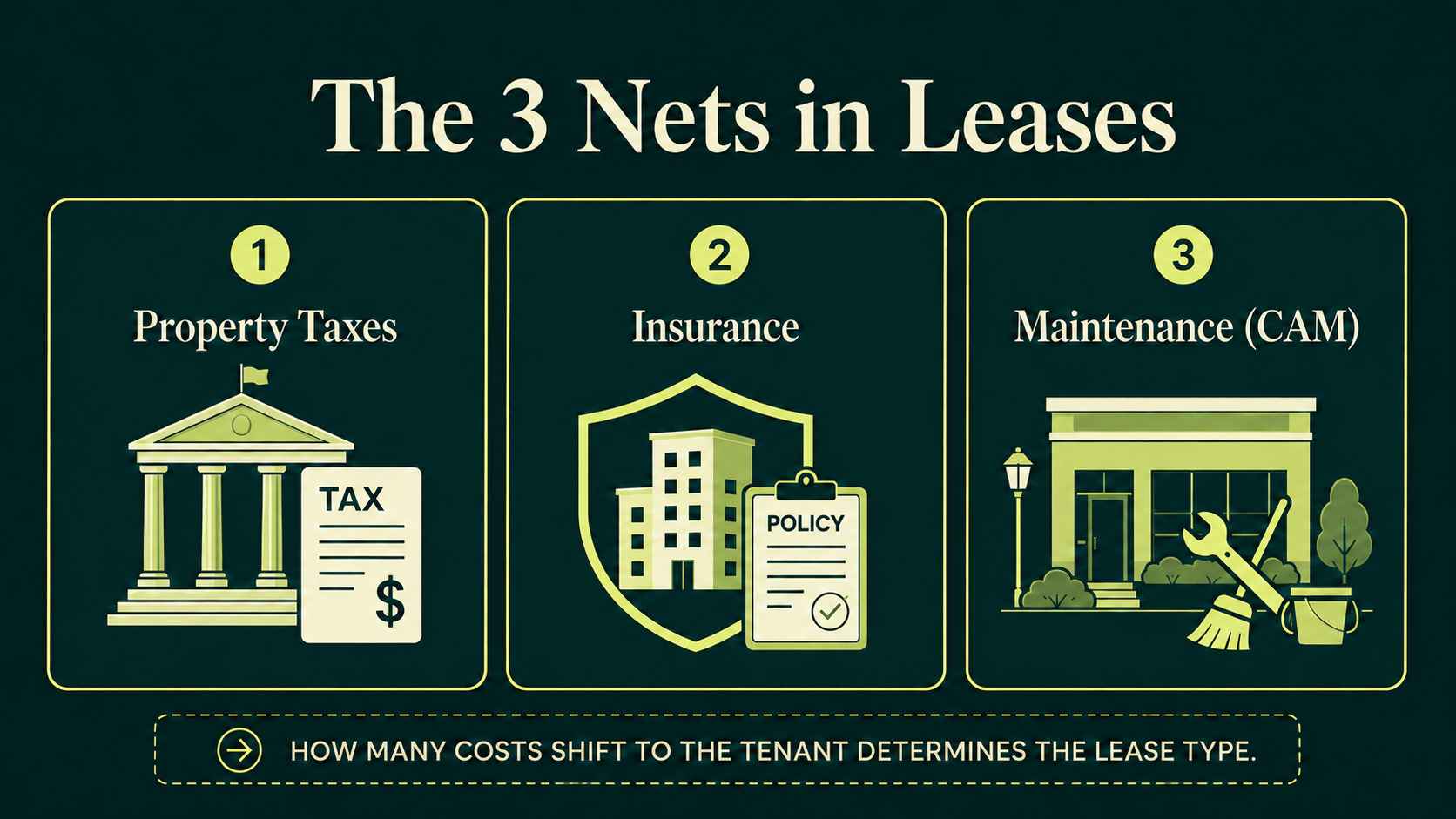
When people talk about net leases, the "nets" refer to three categories of property expense that can be shifted onto the tenant:
- Property taxes charged on the building and land.
- Insurance premiums for the property itself.
- Maintenance, often written as common area maintenance (CAM) or operating expenses, covering upkeep of the building and shared spaces.
How many of these three the tenant takes on is exactly what separates a single net lease from a double or triple net lease.
The Types of Net Leases
There are three standard net lease structures, plus one more extreme version. Here is who pays what in each:
Single Net Lease (N)
In a single net lease, the tenant pays base rent plus the property taxes. The landlord still covers insurance and maintenance. To offset the added tax burden, the base rent is usually lower. Single net leases are the least common of the three, because landlords who want to pass off costs usually go further with a double or triple net structure.
Double Net Lease (NN)
A double net lease adds insurance to the mix. The tenant now pays base rent, property taxes, and the property insurance premium, while the landlord remains responsible for structural upkeep and maintenance. Double net leases are common in multi-tenant properties, where each tenant pays a proportional share of taxes and insurance based on the square footage they occupy.
Triple Net Lease (NNN)
The triple net lease is the one you will see most often, and it is what most investors mean when they talk about net lease real estate. The tenant pays base rent plus all three nets: property taxes, insurance, and maintenance. The landlord collects a rent check with minimal day-to-day involvement.
One important detail: in a standard NNN lease, the landlord often still retains responsibility for the roof and structure of the building. A listing advertised as "NNN" might include that carve-out, or it might not, so the exact wording of the lease matters.
Absolute Net (Bondable) Lease
An absolute net lease, sometimes called a bondable lease, is the most hands-off version for an owner. The tenant takes responsibility for everything, including the roof, the structure, and even rebuilding after a disaster. There are essentially no landlord obligations left. These leases are typically reserved for investment-grade single tenants whose strong credit effectively backs the obligation, and they are considered the purest form of passive real estate ownership.
Why Investors Like Net Leases
Net leases, and triple net leases in particular, have a reputation for producing something close to truly passive income. Here is why investors are drawn to them:
- Predictable, bond-like income: Because the tenant absorbs operating costs, the owner's net income stays stable even when taxes or insurance rise. The rent check behaves a lot like a coupon payment on a bond.
- Minimal management: A single-tenant NNN property can require very little hands-on involvement, which appeals to investors who want exposure to real estate without the operational grind.
- Long lease terms: Net leases commonly run 10 to 25 years, often with renewal options, locking in occupancy for years at a time.
- Creditworthy tenants: Many net lease properties are occupied by national chains, pharmacies, dollar stores, fast-food brands, and other established businesses, which lowers the risk of missed rent.
- Inflation protection: These leases frequently include scheduled rent escalations, so income climbs over the term rather than staying flat.
- Lender appeal: Predictable cash flow from a creditworthy tenant makes NNN deals straightforward to finance, and they are popular vehicles in 1031 exchanges.
On the pricing side, net lease properties are typically valued using a cap rate, which is the annual net rent divided by the purchase price. Properties with investment-grade tenants and long remaining terms tend to trade at lower cap rates, while weaker tenants, shorter terms, or secondary locations push cap rates higher. According to National Association of Realtors data, investment-grade NNN properties with long terms have generally traded in roughly the 5% to 6% cap rate range, though those numbers move with interest rates and market conditions.
The Risks and Trade-offs
A net lease is not free money, and the "passive" label only holds up to a point.
For owners, the biggest risk is concentrated in a single word: the tenant. If a single tenant on a long NNN lease goes dark or defaults, the income does not just dip, it stops. That is why tenant creditworthiness sits at the center of every net lease valuation. There is also re-tenanting risk when a long lease finally expires, and the lower base rent means the upside per square foot is thinner than an actively managed property.
For tenants, the trade-off runs the other way. A lower base rent is appealing, but the tenant now absorbs the volatility of taxes, insurance, and maintenance. If the property tax assessment jumps or insurance premiums spike, that increase lands on the tenant, not the landlord.
The takeaway is to read the lease closely. Vague language around what counts as maintenance, how CAM is calculated, or who handles a structural repair can shift real money from one party to the other.
How Insurance Works in a Net Lease
Here is the piece that often gets glossed over, and it matters more than people expect: in a double or triple net lease, insurance is one of the costs the tenant takes on. That sounds like the owner is off the hook. They usually are not.
In practice, property insurance is handled one of two ways. In many structures the owner carries the policy and the tenant reimburses the premium. In others, the tenant carries coverage directly and names the owner as an additional insured. Either way, the owner has a strong interest in confirming that coverage actually exists, that the limits are adequate, and that it protects their stake in the building.
Owners typically still need their own coverage even in a triple net deal, for a few reasons:
- Lenders require it. A mortgage on the property usually comes with insurance requirements the owner must satisfy regardless of lease terms.
- The owner still owns the building. In a standard NNN lease, structural elements like the roof often remain the owner's responsibility, which means an insurable interest the tenant's policy may not fully cover.
- Gaps and vacancies happen. If a tenant's policy lapses, a tenant leaves, or the property sits empty between leases, the owner's coverage is the safety net.
In short, a net lease changes who pays for insurance, but it rarely changes the fact that a property owner needs protection in place.
Protect the Asset Behind the Income
A net lease can shift property taxes, maintenance, and even insurance onto your tenant. What it cannot shift is the fact that you still own the building, and protecting that stake is on you.
That is where Obie comes in. We have spent years making insurance fast and straightforward for real estate investors, turning a slow, paperwork-heavy process into a quote you can get in minutes. Whether you are adding a single-tenant NNN property to your portfolio or managing a multi-tenant building, we help you make sure the right coverage is in place to protect your investment.
Get a quote in minutes and keep your income protected, no matter how the lease is structured.



.svg)