
.jpeg)


If 2023 through 2025 were the years cities cracked down on short-term rentals, 2026 is the year the country split in two directions at once. Some states passed laws protecting hosts from local bans. Others handed cities powerful new enforcement tools. For investors, the result is a map where the same Airbnb strategy can be newly protected in one state and newly impossible in the next.
Here’s what actually changed in 2026 and what it means for how you operate, as of October 2026. Rules move quickly in this space, so treat this as a starting point and verify current requirements in your market before acting.
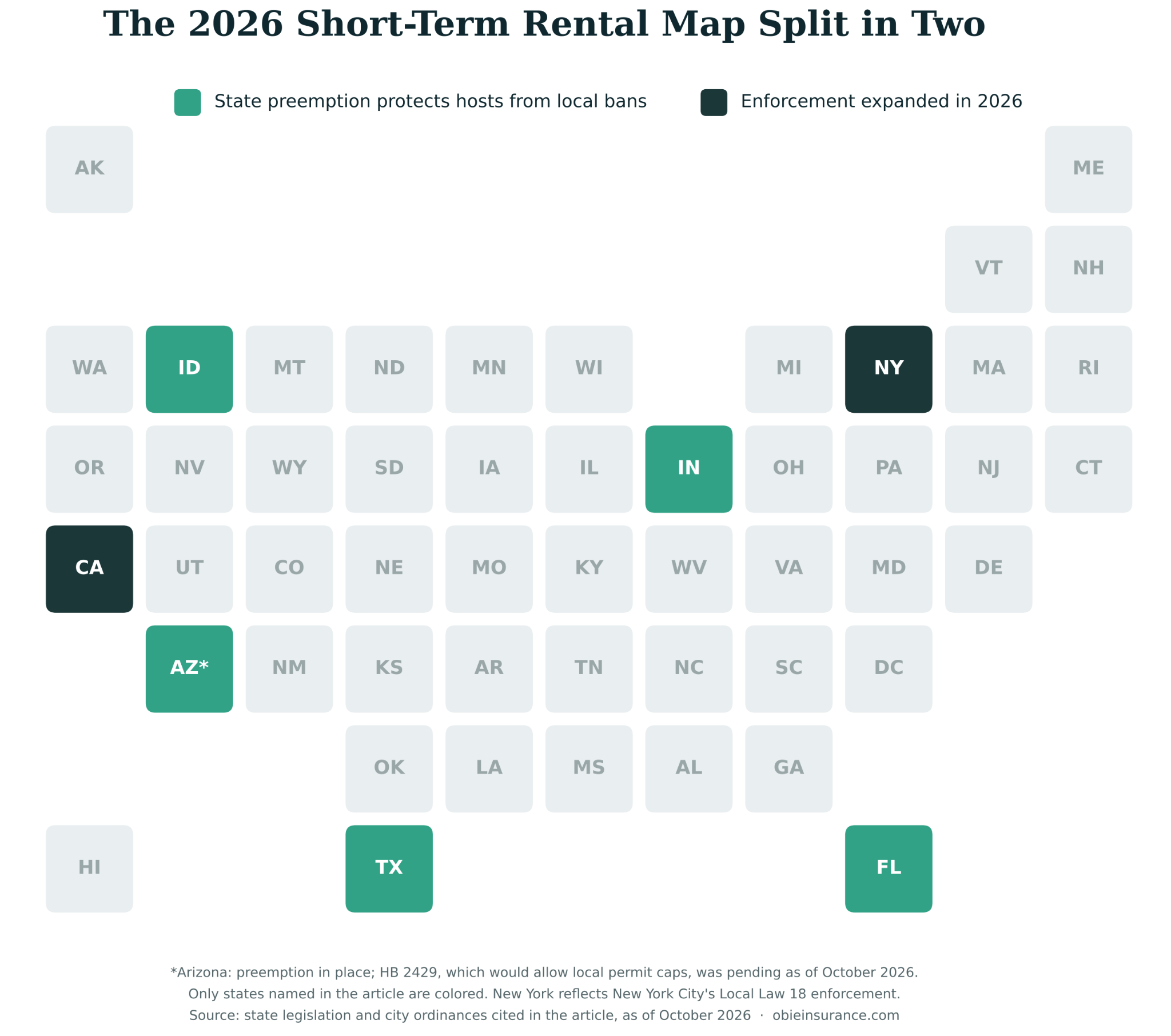
The big shift: states are overruling cities, in both directions
The defining trend of 2026 is state preemption: state laws that limit what cities can do about short-term rentals.
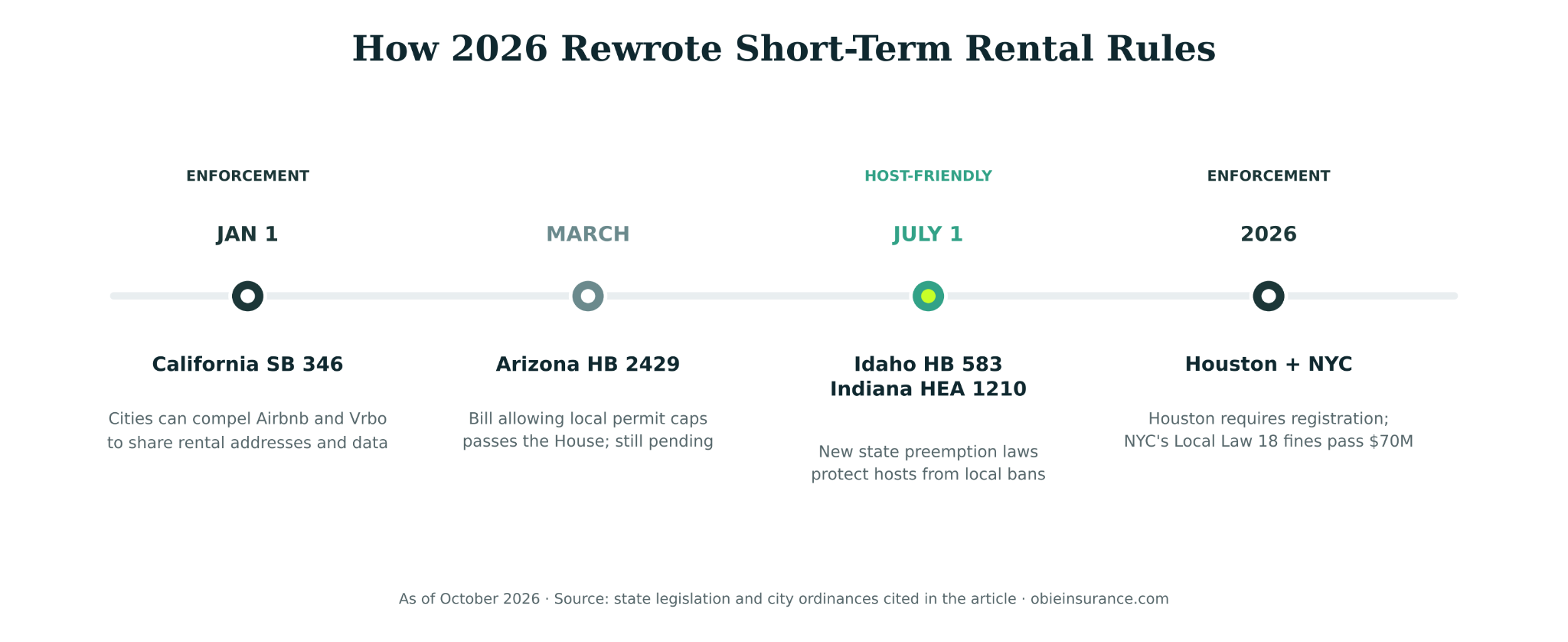
Idaho passed HB 583, effective July 1, 2026, requiring local governments to treat short-term rentals like any other residential use. Owner-occupancy requirements, rental-night caps, and proximity limits between rentals are now off the table for Idaho cities.
Indiana followed the same path with HEA 1210, also effective July 1, which bars cities and counties from capping the number of rental properties, short-term rentals included. Cities keep their authority over safety standards, inspections, registration, and occupancy limits, but they can no longer limit how many rentals exist.
Idaho and Indiana join the states with established preemption frameworks, including Texas, Arizona, and Florida, where a statute sets a floor no city ordinance can drop below. For investors, preemption matters because it makes nightly-rental income durable enough to plan around: a city council vote can’t erase your business model overnight.
One watch item in that group: Arizona’s HB 2429, which would let cities apply occupancy formulas and permit caps in some areas, passed the Arizona House in March 2026 and was still moving through the legislature as of mid-year. If you operate in Arizona, check its current status.
The other direction: enforcement got real teeth
While some states protected hosts, the enforcement side of the map got sharper too, and the mechanism changed. The new enforcement engine isn’t inspectors knocking on doors. It’s data.
California’s SB 346, effective January 1, 2026, lets any city that adopts an enabling ordinance compel platforms like Airbnb and Vrbo to hand over the physical addresses of every short-term rental operating in their jurisdiction, with reporting at least quarterly. Enforcement capability that took New York City years to build is now available to any California city that passes an ordinance.
New York City’s Local Law 18 continued its aggressive enforcement run through 2026, with cumulative fines reportedly crossing $70 million. Entire-unit short stays remain effectively prohibited in most buildings, and the city stands as the clearest proof that regulation can remove an STR market’s premium entirely: short-term listings fell dramatically while long-term listings rose.
Houston joined the registration wave, with a new ordinance requiring short-term rental registration and safety compliance taking effect in 2026.
And the quieter story: the crackdown moved down-market. Small and mid-sized cities advanced short-term rental ordinances in waves through 2026, often borrowing registration and platform-verification language from the big-city playbooks. If your properties are in smaller markets precisely because the rules were lighter there, that assumption now needs an annual check.
The common thread: platforms are now part of enforcement
Across nearly every new rule, one pattern repeats: cities are regulating through the platforms, not around them. Registration numbers verified before a listing goes live. Non-compliant listings removed by the platform. Booking data shared with local governments.
Practically, this means non-compliance no longer looks like a fine you might never receive. It looks like your listing disappearing, and your income with it.
What this means for your insurance
Regulation and insurance intersect in three places investors tend to discover late:
Compliance is increasingly an insurability question. Some ordinances require minimum liability coverage as a condition of the permit, commonly in the $500,000 to $1 million range in cities that take this approach. Your policy’s liability limit is now a licensing document, not just protection.
A regulatory shutdown is not a covered loss. Loss of income coverage on a short-term rental policy responds when a covered event like a fire makes the property unusable. It does not pay when a city ordinance ends your ability to rent, or a platform delists you. The financial cushion for regulatory risk is diversification and compliance, not insurance.
How you rent determines what policy you need. If regulation pushes you from nightly stays toward 30-plus-day or annual tenants, your insurance needs to move with you: short-term rental coverage, mid-term arrangements, and landlord policies are different products, and operating on the wrong one is the kind of gap that surfaces at claim time. Our guide to short-term rental insurance covers where the lines fall, and our breakdown of coverage and costs goes deeper on liability limits.
A practical checklist for Q4 2026
- Verify your registration status in every market you operate, even ones where you registered before. Several 2026 ordinances added renewal and safety-compliance steps to existing programs.
- Check whether your state gained or lost preemption protection this year. It changes how much weight to put on local political risk when underwriting your next deal.
- Confirm your liability limits meet your permit requirements, not just your risk tolerance.
- Stress-test the portfolio against a delisting, since platform removal is now the standard enforcement outcome. If one market went dark, what carries the portfolio?
- Match each property’s policy to how it actually rents today, not how it rented when you bought it.
The investors navigating 2026 best aren’t the ones avoiding regulated markets. They’re the ones treating regulation as a known operating cost: registered, properly insured, and positioned to pick up demand as undercapitalized operators exit. Coverage that fits how your property actually operates is the part we can help with. Get a quote in minutes.


.svg)